Question 1 of 3Difficulty ●●●●●
An α-particle is a helium nucleus. It is made of 2 protons and 2 neutrons.
What is the relative charge of an α-particle?
GCSE Physics practice questions on atoms and nuclear energy. Try 3 for free below — with hints, the answer and why the wrong answers are tempting. GCSE Beast has 28 questions on this topic, from first steps to the hardest exam-style problems.
An α-particle is a helium nucleus. It is made of 2 protons and 2 neutrons.
What is the relative charge of an α-particle?
A student uses a tablet simulation of α-particles fired at a very thin sheet of platinum. The screen zooms in on two platinum nuclei and shows the paths of five α-particles, numbered 1 to 5.
Which row gives a correct conclusion from each set of paths?
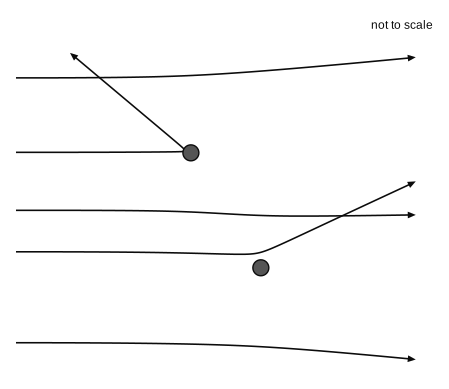
| paths 1, 3 and 5 show that | path 2 shows that | |
|---|---|---|
| A | most of the atom is empty space | the nucleus is positive and has a large mass |
| B | the nucleus is positive and has a large mass | most of the atom is empty space |
| C | most of the atom is empty space | the α-particle bounced off an electron |
| D | the atom contains electrons | the nucleus contains neutrons |
One way in which a uranium-235 nucleus can split is shown by the equation
23592U + 10n → 14055Cs + X + 2 10n
Which symbol represents nucleus X?