GCSEBeast

States of matter and kinetic theory

GCSE Chemistry practice questions on states of matter and kinetic theory. Try 3 for free below — with hints, the answer and why the wrong answers are tempting. GCSE Beast has 16 questions on this topic.

Question 1 of 3Difficulty ●●●●●

Gallium is a soft, silvery metal. It melts at 30 °C and boils at about 2200 °C, so a piece of gallium melts when it is held in a warm hand at 37 °C.

Fig. 1 shows the arrangement of gallium atoms in three different states, P, Q and R.

Which row shows the box for gallium at 37 °C and describes the movement of its atoms?
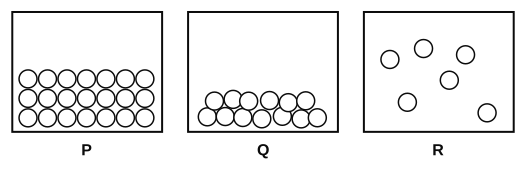
Fig. 1: Three boxes of identical circles labelled P, Q and R: in P the circles are in regular rows; in Q they touch but are jumbled in the lower part of the box; in R a few circles are spread far apart.

Fig. 1

boxmovement of the atoms
APvibrate about fixed positions
BQvibrate about fixed positions
CQmove around and slide past each other
DRmove quickly and randomly in all directions
Question 2 of 3Difficulty ●●●●●

A syringe contains air. The end of the syringe is sealed and the plunger can move freely, so the pressure of the air stays the same. The syringe is put into a bowl of warm water and the plunger moves out.

Which row describes the particles in the air in the syringe as it warms up?

average speed of the particlessize of the particlesdistance between the particles
Aincreasesincreasesstays the same
Bincreasesstays the sameincreases
Cstays the samestays the sameincreases
Ddecreasesstays the sameincreases
Question 3 of 3Difficulty ●●●●●

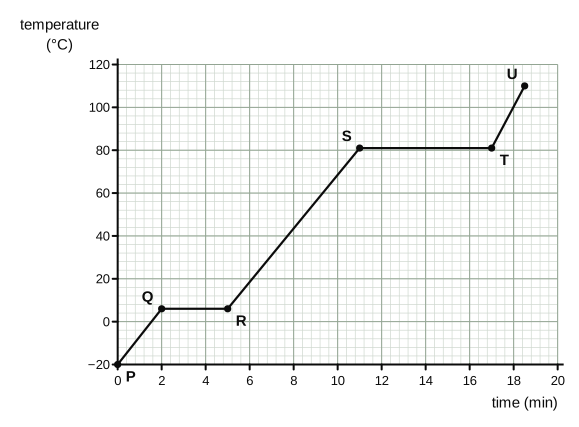
A pure solid hydrocarbon is taken from a freezer and heated steadily until it has all turned into a gas. Fig. 1 shows how its temperature changes.

Which row describes the substance while it is boiling?

Fig. 1: Graph of temperature from −20 to 120 °C against time from 0 to 20 min. The line rises from P to Q, is flat from Q to R, rises from R to S, is flat from S to T, then rises from T to U.

Fig. 1

section of the graphaverage kinetic energy of the particlesthe energy taken in is used to
AQ to Rstays the sameovercome the forces of attraction between molecules
BS to Tincreasesovercome the forces of attraction between molecules
CS to Tstays the sameovercome the forces of attraction between molecules
DS to Tstays the samebreak the covalent bonds inside the molecules