GCSEBeast

Boyle's law: pressure and volume of a gas

GCSE Physics practice questions on boyle's law: pressure and volume of a gas. Try 3 for free below — with hints, the answer and why the wrong answers are tempting. GCSE Beast has 12 questions on this topic, from first steps to the hardest exam-style problems.

Question 1 of 3Difficulty ●●●●●

A nurse seals the nozzle of a plastic syringe holding 80 cm³ of air at a pressure of 100 kPa. The plunger is then pushed in slowly until the volume of the air is 20 cm³. The temperature of the air does not change.

What is the new pressure of the air?
Question 2 of 3Difficulty ●●●●●

Scientists live for a few days in a small laboratory on the sea bed. The air in the laboratory is at the same pressure as the water outside, a total of 250 kPa (this includes the pressure of the atmosphere).

A scientist seals 1800 cm³ of this air in a large, loosely filled plastic bag and takes it up to the surface, where the pressure is 100 kPa. The temperature of the air does not change.

What is the volume of the air in the bag at the surface?

Question 3 of 3Difficulty ●●●●●

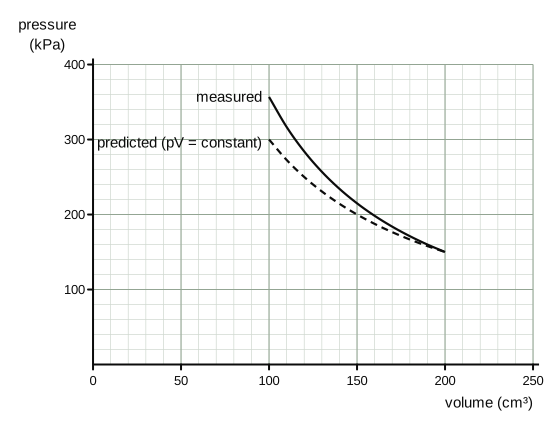
A student compresses some gas in a sealed cylinder from 200 cm³ to 100 cm³. At the start, the pressure is 150 kPa.

The graph shows the pressures predicted by pV = constant (dashed curve) and the pressures measured (solid curve).

Which statement explains the difference between the two curves?

: Graph of pressure in kPa (0 to 400) against volume in cm³ (0 to 250). Both curves start at 200 cm³ and 150 kPa and rise as the volume decreases to 100 cm³. The dashed curve, labelled predicted (pV = constant), reaches 300 kPa at 100 cm³. The solid curve, labelled measured, lies above it and reaches about 360 kPa at 100 cm³; the gap between them grows as the volume gets smaller.