Question 1 of 3Difficulty ●●●●●
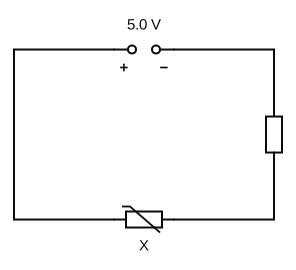
The diagram shows part of the control circuit of a rice cooker.
What is component X?
GCSE Physics practice questions on series and parallel circuits. Try 3 for free below — with hints, the answer and why the wrong answers are tempting. GCSE Beast has 41 questions on this topic, from first steps to the hardest exam-style problems.
The diagram shows part of the control circuit of a rice cooker.
What is component X?
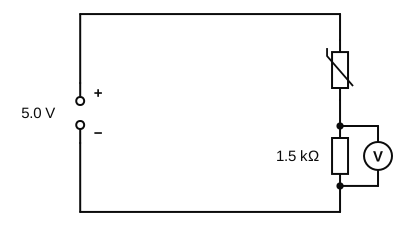
A smart radiator valve senses the room temperature with a thermistor in series with a fixed resistor. A voltmeter is connected across the fixed resistor. The room warms up from 15 °C to 22 °C.
What happens to the current in the thermistor and to the reading on the voltmeter?
| current | voltmeter reading | |
|---|---|---|
| A | decreases | decreases |
| B | decreases | increases |
| C | increases | decreases |
| D | increases | increases |
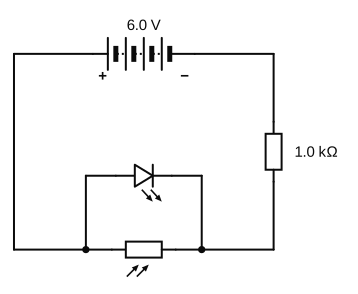
In a night light, an LED is connected in parallel with an LDR. This pair is in series with a 1.0 kΩ resistor and a 6.0 V battery. The LED lights only when the p.d. across it is 2.0 V or more. The resistance of the LDR is 200 Ω in daylight and 20 kΩ in darkness.
Which row shows whether the LED is lit?
| in daylight | in darkness | |
|---|---|---|
| A | lit | lit |
| B | lit | not lit |
| C | not lit | lit |
| D | not lit | not lit |